

Dry vs Wet Cat Food: Which Is Better?
Ask ten cat owners whether dry or wet food is better and you’ll get eleven opinions — it’s one of the most passionately debated questions in feline nutrition, and the rare debate where both sides are partly right. Dry food fans cite convenience, cost, and dental benefits. Wet food devotees point to hydration, naturalness, and the simple logic that cats evolved eating moist prey, not crunchy pellets. Both sides have genuine points, and both have myths that need retiring.
This guide settles the dry vs wet cat food debate the honest way: comparing the two formats across nutrition, hydration, dental health, weight management, cost, and convenience — then showing you why the best answer for most cats isn’t “either/or” but a smart combination. By the end, you’ll know exactly how to build your cat’s ideal dry-wet balance — and how to read any label, in either format, with confidence.

🐾 Key Takeaways
- Moisture is the fundamental difference — wet food is ~75–80% water, dry food ~10%; everything else flows from that gap.
- Both formats can be complete and balanced — nutritional adequacy depends on formulation, not format; check the label’s adequacy statement.
- Wet food wins on hydration — crucial for cats, whose low thirst drive makes urinary and kidney health a lifelong concern.
- Dry food wins on convenience and cost — but its dental benefits are modest and often overstated.
- The best answer is usually “both” — mixed feeding captures wet food’s hydration with dry food’s practicality; do the calorie math for each part.
- Compare on calories, not volume — a can of wet food looks like a feast but may hold fewer calories than a small scoop of kibble.
The Core Difference: It’s About Water
Strip away the marketing and the dry vs wet debate is, at bottom, a water debate. Wet (canned) cat food typically contains 75–82% moisture. Dry kibble contains around 8–12%. That single difference drives nearly every practical distinction between the formats:
- Calorie density: water has no calories, so wet food is far less calorie-dense per bite. A 3-oz can might contain 70–100 kcal; the same volume of kibble could hold several times that. This is why our cat portion guide insists on comparing formats by calories, never by volume — eyeballing equal volumes of wet and dry food is one of the most common feline feeding errors.
- Satiety: the water and bulk in wet food help cats feel full on fewer calories — a genuine advantage for weight management.
- Palatability: most cats find wet food’s aroma and texture more appealing (it’s closer to prey in moisture and mouthfeel), which matters for picky eaters, seniors, and cats with reduced appetite.
- Spoilage: moisture is also wet food’s weakness — once opened, it spoils within hours at room temperature and needs refrigeration. Dry food’s low moisture is what makes free-feeding and all-day grazing possible.
Everything below — hydration, dental, cost, convenience — is a consequence of this moisture gap. Keep it in mind and the debate stops feeling tribal: you’re choosing how much water comes with the nutrition, and how much your cat drinks around it.
Nutrition: Format Doesn’t Determine Quality
Here’s the myth to retire first: neither format is inherently more nutritious. A complete-and-balanced dry food and a complete-and-balanced wet food both meet the same AAFCO nutrient profiles — the adequacy statement on the label (explained in our cat food label guide) is what guarantees nutritional completeness, not the format.
That said, typical formulations do differ in emphasis:
Protein and fat: wet foods often (not always) run higher in animal protein and fat on a dry-matter basis, with fewer carbohydrates — closer to a cat’s carnivore-leaning needs. Dry foods need starch for kibble structure, so they typically carry more carbs. But these are tendencies, not rules: premium dry foods can be high-protein, and cheap wet foods can be starchy. Read the guaranteed analysis, not the format.
Ingredient quality varies within both formats. There are excellent and mediocre foods in cans and bags alike. The manufacturer’s standards, ingredient sourcing, and formulation expertise matter far more than whether the food is wet or dry — a point our budget vs. premium guide makes about pet food generally.
The practical nutritional edge: for most cats, wet food’s typical macro profile (higher protein, lower carb, built-in hydration) aligns slightly better with feline biology — which is why many vets lean toward recommending some wet food in the diet. But “some” is doing heavy lifting in that sentence. A high-quality dry food as the dietary base with wet food as a meaningful complement beats a low-quality all-wet diet built on the cheapest cans.
Hydration: Wet Food’s Decisive Advantage
If wet food has one undisputed victory, it’s hydration — and for cats, hydration is not a minor perk. It’s central to feline health.
Cats are desert animals with low thirst drive. Evolved from desert-dwelling ancestors, cats have a naturally weak urge to drink water — they’re designed to get most of their moisture from prey (which, like wet food, is ~70% water). A cat eating only dry food must drink substantially more water to compensate, and many simply don’t drink enough. Studies of feline water intake consistently show that cats on wet-food diets consume significantly more total water (food + drinking) than cats on dry-only diets.
Why it matters: urinary and kidney health. Chronic low-level dehydration concentrates the urine, and concentrated urine is implicated in feline lower urinary tract issues — including the crystal and stone formation that plagues many cats, especially males. Kidney disease, heartbreakingly common in senior cats, also progresses in a hydration-sensitive context. No food format prevents these conditions, but supporting generous water intake through wet food is one of the most evidence-aligned dietary steps an owner can take. Our cat nutrition guide covers water’s role as the forgotten nutrient in more depth.
Dry-food hydration strategies (for cats who refuse wet food — they exist, and they’re stubborn): multiple water stations, wide shallow bowls (whisker-friendly), running-water fountains (many cats strongly prefer moving water), and adding water or broth to kibble. These help, but rarely close the gap fully — which is why the mixed-feeding approach below is so valuable even for wet-food skeptics.
How to tell hydration is working: you can’t measure it precisely at home, but the proxies are observable — regular, pale-yellow urine in the litter box (dark, scant, or strong-smelling urine suggests under-hydration), good skin elasticity, and moist gums. If your cat’s urine output seems low or unusually concentrated on a dry-only diet, that’s a concrete signal to push harder on wet food or fountains — and worth mentioning at the next vet visit.
Reading Labels Across Formats: Compare Fairly
One more skill makes the dry-wet comparison honest: comparing labels across formats requires dry-matter math. Guaranteed analysis percentages look wildly different because wet food’s numbers are diluted by water — a wet food showing 10% protein and a dry food showing 30% protein may be nearly equivalent once water is removed.
The quick conversion: divide the nutrient percentage by the dry-matter fraction (100% minus moisture %). A wet food at 10% protein and 78% moisture: 10 ÷ 0.22 ≈ 45% protein on a dry-matter basis — actually higher than many kibbles. You don’t need to do this for every purchase, but run it once when comparing two specific foods and the “which is more nutritious” question answers itself.
Also note: calorie statements hide in different places by format — kcal/kg on almost everything, plus kcal/can on wet and kcal/cup on dry. When mixed-feeding, convert both to daily kcal (cans × kcal/can, cups × kcal/cup) and add. Our label guide walks through finding every one of these numbers.
The Dental Question: What Dry Food Can (and Can’t) Do
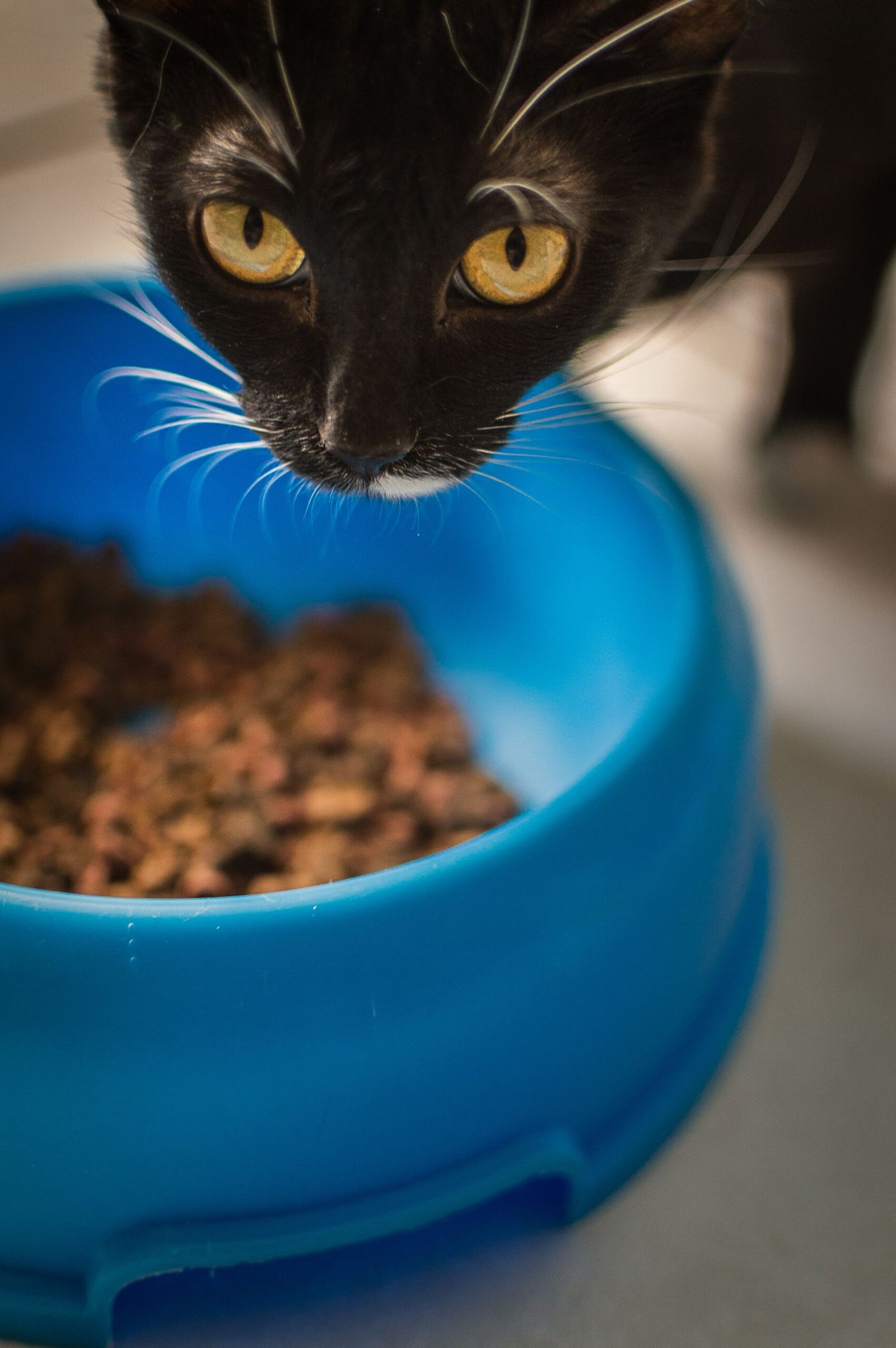
Dry food’s most-cited health claim is dental: the crunching action supposedly cleans teeth. Time for an honest assessment, because this claim is both partly true and widely oversold:
What kibble does: the mechanical action of crunching can provide mild abrasive cleaning on tooth surfaces — better than nothing, and one reason exclusively wet-fed cats sometimes accumulate tartar faster. Some kibbles are specifically engineered (larger size, fibrous texture) to maximize this scrubbing effect; ordinary small kibble does much less, since many cats swallow pieces whole or shatter them with minimal tooth contact.
What kibble doesn’t do: replace brushing, prevent dental disease, or clean below the gumline where periodontal disease actually happens. The “dry food cleans teeth” claim implies a dental-hygiene equivalence that doesn’t exist. Cats on lifelong dry diets still develop dental disease routinely — any vet dentist will confirm it.
The balanced view: dry food offers a modest dental adjunct, not dental care. The real dental hierarchy: professional veterinary dental care as needed > tooth-brushing (trainable in many cats, starting young helps enormously) > dental-specific diets or treats as support > ordinary kibble’s incidental crunching > nothing. Don’t choose dry food for dental reasons alone — and don’t let the dental claim stop you from feeding wet food. The hydration benefits of wet food outweigh the modest dental edge of dry for the vast majority of cats.
Cost, Convenience, and the Practical Realities
Nutrition debates happen in the abstract; feeding happens in real kitchens. Here’s the practical scorecard:
Cost: dry food is substantially cheaper per calorie — often dramatically so. Feeding a cat entirely on premium wet food can cost several times what quality dry costs. For multi-cat households, the difference is budget-defining. This is a legitimate factor, not a compromise to apologize for: a good dry food fed consistently beats an unaffordable wet-food ideal abandoned after a month.
Convenience: dry food wins outright. It can be measured in seconds, left out for grazing (where appropriate — see our cat portion guide on free-feeding trade-offs), stored easily, and used in puzzle feeders. Wet food demands can-opening, refrigeration of leftovers, prompt bowl-cleaning (spoiled wet food is a bacterial risk and a smell), and a cat who’s present at mealtimes.
Mess and smell: wet food is smellier, messier, and attracts flies in warm weather. Dry food is tidy. Anyone who’s managed both knows this isn’t trivial — feeding routines survive on convenience.
Travel and sitters: dry food simplifies pet-sitter instructions enormously (“one scoop, twice daily” vs. can math and fridge management). For households that travel, a dry-food base with wet as the at-home complement is often the sustainable answer.
The honest conclusion: practicality is part of nutrition. The best diet is the one fed consistently, correctly portioned, for years. A mixed approach that respects your budget, schedule, and sanity will outperform a theoretically perfect plan that collapses under real-life friction.
Weight Management: The Format Factor
Format influences weight control in underappreciated ways:
Wet food’s satiety advantage is real. The water bulk and typical higher-protein profile mean cats often feel satisfied on fewer calories — helpful for weight-loss plans and for the “always hungry” cat. Our cat portion guide notes that splitting food into wet-based meals with measured dry grazing is a favored veterinary strategy for exactly this reason.
Dry food’s calorie density is the risk. Small volumes, big calories — the classic overfeeding trap. A “little extra kibble” is never little calorically. Dry-food weight gain is usually portion error, not format destiny: measured precisely, dry food maintains weight fine. But the margin for error is thinner, and free-fed dry food plus a treat-generous household is the most common recipe for feline obesity.
The verdict: neither format inherently slims or fattens — calories do. But wet food’s structure (bulky, satiating, harder to over-serve casually) gives owners a wider margin of error, which in practice makes weight management easier. If your cat is overweight, shifting calories toward wet food while measuring everything is one of the highest-leverage changes available — alongside the portion discipline from our feeding guide.
The Smart Answer: Mixed Feeding Done Right
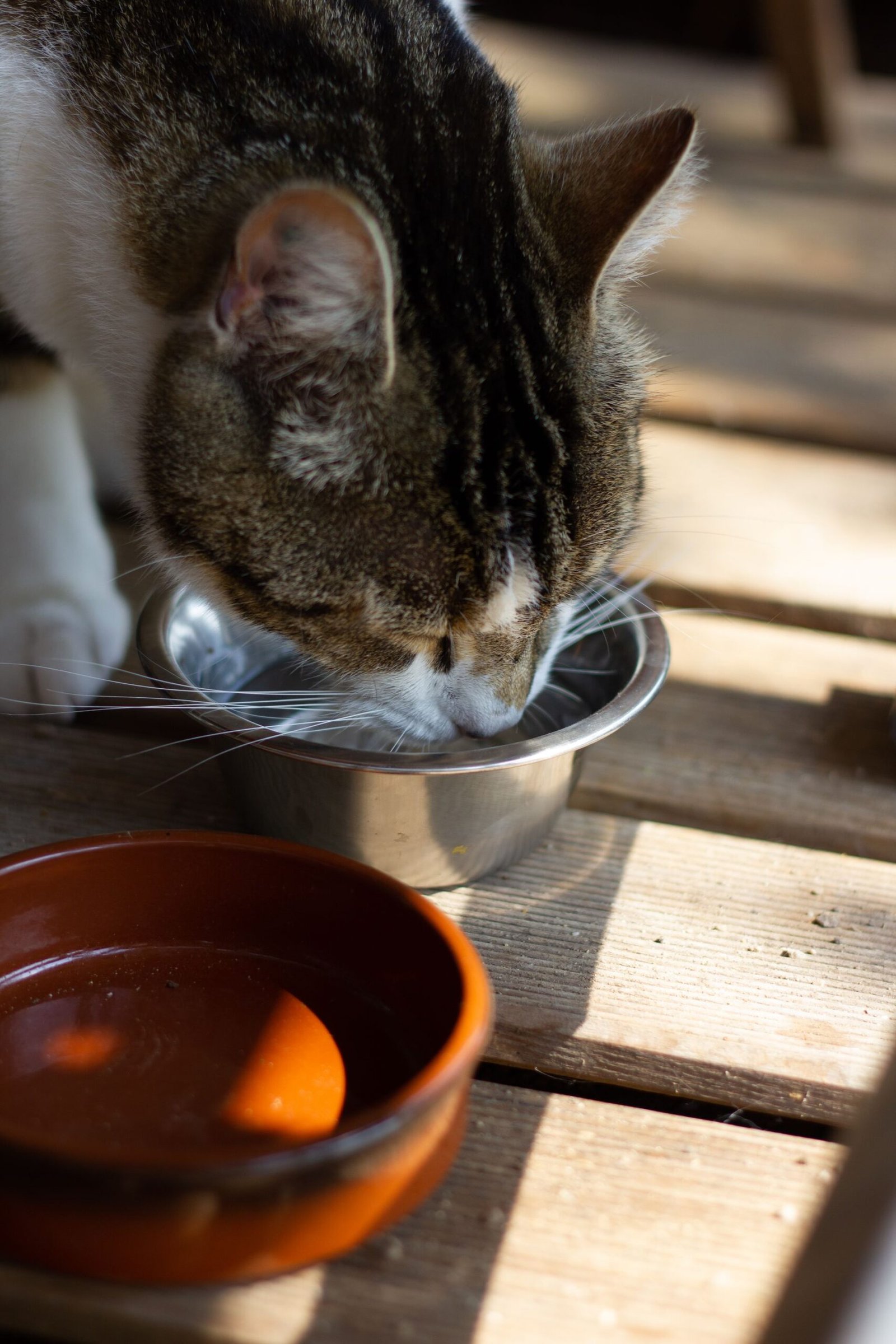
For most cats, the optimal strategy isn’t dry or wet — it’s both, deliberately combined: wet food for hydration, palatability, and satiety; dry food for cost, convenience, dental adjunct, and enrichment (puzzle feeders). Here’s how to run it:
The 50/50 starting template. Feed roughly half the day’s calories as wet food (typically one or two meals) and half as dry (a meal or measured grazing portion). Adjust the ratio to your cat, budget, and schedule — 70/30 either direction is fine; the principle is both formats present, not a magic ratio.
Do the calorie math separately. This is the step everyone skips: calculate the wet portion’s calories (kcal per can × cans) and the dry portion’s calories (kcal per cup × cups), and make them sum to the daily target. Don’t halve each by volume — a “half can + half scoop” eyeball routinely misfires because the calorie densities differ so wildly. Write the numbers down once; the routine then runs itself.
Transition gradually. Cats are neophobic about food textures — a dry-food devotee may regard wet food with deep suspicion. Introduce it slowly: a teaspoon alongside the usual meal, increasing over 1–2 weeks. Warming wet food slightly (to mouse temperature, so to speak) boosts aroma and acceptance. Never starve a cat into accepting a new food — cats who don’t eat for even a day or two risk serious liver complications, so transitions must stay voluntary.
Serve wet food as meals, dry as structure. A practical rhythm: wet food for the morning and evening meals (when you’re present, bowls get cleaned promptly), measured dry food available for midday grazing or puzzle-feeding. This captures wet food’s benefits where they matter most while keeping dry’s convenience working for you.
Multi-cat note: mixed feeding in multi-cat homes means managing both formats per cat — separate stations, supervised wet meals (pick up after 20–30 minutes), and measured dry portions per cat rather than a communal bowl. More logistics, but the same principle.
🩺 A note from the nutrition desk
This comparison is educational. Cats with urinary tract disease, kidney disease, diabetes, or obesity need individualized dietary plans from their veterinarian — format choice can be medically significant (prescription wet foods, for example, are formulated for specific conditions). Never withhold food to force a diet transition in cats, and consult your vet before major dietary changes in kittens, seniors, or cats with health conditions.
Frequently Asked Questions
Is wet food actually better than dry food for cats?
Wet food has genuine advantages — hydration, satiety, palatability, and typically a more carnivore-aligned macro profile. But “better” overstates it: both formats can be complete and balanced, dry wins on cost and convenience, and the best approach for most cats is a deliberate mix. Think “wet food’s strengths plus dry food’s strengths,” not a winner and a loser.
Can I feed my cat only dry food?
Yes, provided it’s a complete-and-balanced formula fed in measured portions — millions of healthy cats eat dry-only diets. But work harder on hydration (fountains, multiple stations, wet-food toppers if accepted) and be extra disciplined about portions, since dry food’s calorie density punishes eyeballing. Discuss the trade-offs with your vet, especially for male cats or those with urinary history.
Does dry food clean cats’ teeth?
Only modestly — the crunching provides mild surface abrasion, but it doesn’t replace brushing or professional dental care, and many cats swallow kibble with minimal chewing. Don’t choose dry food for dental reasons alone; the hydration benefits of wet food matter more for most cats.
How do I switch my cat from dry to wet food (or add wet food)?
Gradually and voluntarily: start with a teaspoon of wet food alongside the usual meal, increasing over 1–2 weeks. Warming it slightly improves acceptance. Never withhold food to force the switch — cats must not go without eating, so keep the familiar food available throughout the transition.
Is mixed feeding expensive?
It can be managed: even one wet meal daily (or a wet-food topper on dry) captures meaningful hydration benefits at a fraction of all-wet cost. The 50/50 template is a starting point — adjust toward your budget; some wet food consistently fed beats an all-wet ideal you can’t sustain. Buying wet food in multi-packs or larger cans (portioning leftovers into sealed containers) trims the cost further.
My cat refuses wet food entirely. What should I do?
Some cats are committed dry-food loyalists. Don’t force it — instead, maximize dry-food hydration (water fountains are the highest-leverage move; many wet-food refusers drink enthusiastically from fountains), consider adding water or low-sodium broth to kibble, and keep offering small amounts of varied wet textures occasionally (tastes change). A well-hydrated dry-fed cat beats a stressed, under-eating cat every time.
Conclusion: Stop Choosing Sides
The dry vs wet cat food debate persists because both sides are holding real advantages — hydration, satiety, and palatability on one side; cost, convenience, and mild dental action on the other. The resolution isn’t a verdict but a recipe: feed both, on purpose, with the calorie math done. Wet food for the moisture your desert-descended cat won’t drink enough of on their own; dry food for the practicality that keeps the routine sustainable for years.
Start where you are: add one wet meal to a dry-fed cat’s day, or add measured dry structure to a wet-fed cat’s routine. Calculate the calories, watch the water intake, note the coat and energy — and let your cat’s response refine the ratio over the coming weeks. Revisit the balance at life-stage changes (kitten to adult, adult to senior), since hydration needs and appetites shift with age. That’s the whole debate, settled not by ideology but by attention. For the complete feline feeding picture, pair this with our cat portion guide, our cat nutrition basics, and our cat food & nutrition collection — together, they cover every decision the cat food aisle will ever ask you to make.